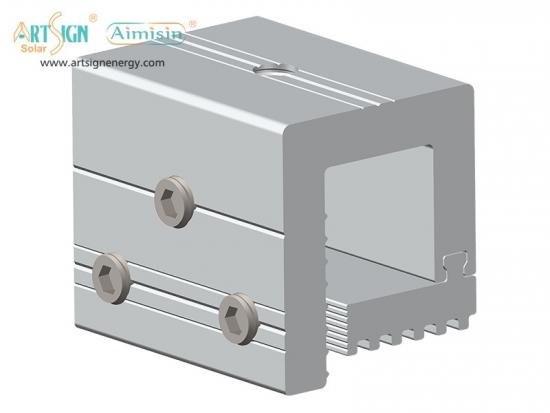
In this market environment, the global standard for solar racking is undergoing a critical security and engineering upgrade.
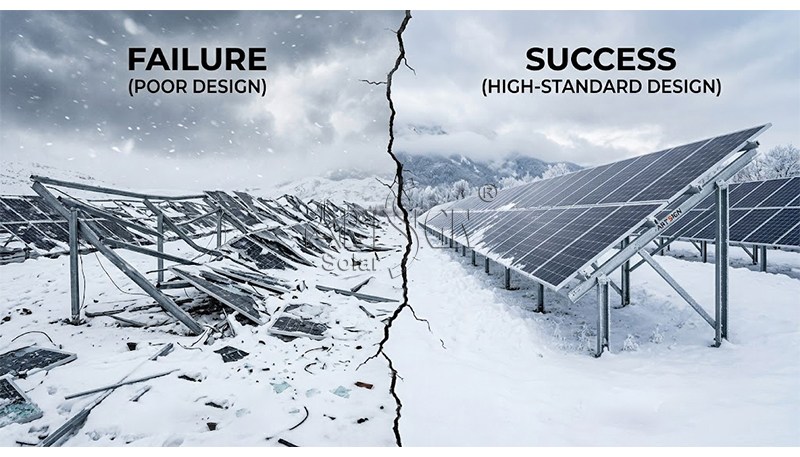
The Rising Stakes: Mechanical Loads and Financial Risk
Historically, solar brackets were often viewed as standard commoditized steel or aluminum hardware. Today, they are evaluated as highly specialized, load-bearing structural elements. When extreme weather strikes, heavy-duty solar mounting structures face two primary physical forces:
Extreme Wind Loads (Uplift & Downforce): High velocity winds create a massive aerodynamic "wing effect" on solar panel arrays. If the static engineering calculations or the quality of materials are insufficient, fasteners can shear, rails can twist, and entire arrays can be torn off roofs or ground foundations.
Heavy Snow Loads (Static Dead Weight): Prolonged blizzards deposit tons of compacted snow on top of solar modules. This static load can cause micro-cracking in the solar cells, bend standard rails, or completely collapse the mounting framework if the structural span is under-engineered.
Furthermore, global insurance compliance has tightened significantly. In 2026, international underwriters are frequently demanding comprehensive wind test document and structural certifications conforming to regional codes (such as AS/NZS 1170 in Australia or Eurocode 3 in Europe) before approving project financing or coverage.
The Security Upgrade: How Modern Solar Brackets Fight Back
To protect investments over a 25-year lifecycle, modern solar racking manufacturing must evolve past baseline safety margins. True structural security requires a multi-layered engineering approach:
1. Advanced Material Optimization (AL6005-T5 & ZAM)
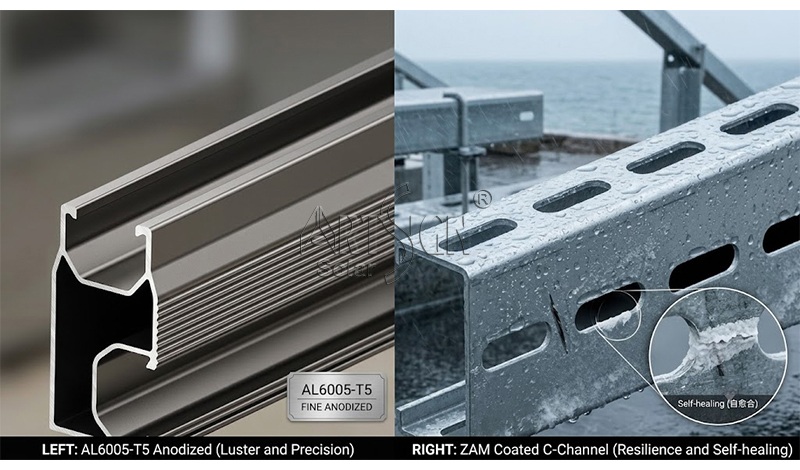
Standard commercial carbon steel is no longer suitable for high-risk environments. Engineers are relying on premium materials with proven tensile resilience . For rooftop mounting ,Anodized Aluminium Alloy (AL6005-T5) provides high tensile strength paired with lightweight flexibility, ensuring the structure absorbs mechanical stress without fracturing. For massive ground arrays , Zinc-Aluminum-Magnesium (ZAM) Coated Steel delivers heavy-duty structural rigidity alongside self-healing anti-corrosion properties.
The weakest link in a solar array is rarely the middle of a solid rail—it is at the connection joints. Security upgrades focus heavily on heavy-duty mid/end-clips, anti-slip clamp designs, and reinforced rail splices. Ensuring these localized contact points distribute mechanical forces evenly across the entire structural sub-frame prevents localized failure.
For solar distributors and project managers, squeezing procurement costs by purchasing low-grade, under-engineered solar brackets is a high-risk gamble. The slight upfront savings on unverified structural components are entirely offset by the risk of structural collapse, voided product warranties, and rejected insurance claims.
Factory Perspective: As a mature solar support structure manufacturer with 20 years of professional production and export experience, we are well aware that structural integrity cannot be compromised. Our internal engineering team will fully customize the wind load and snow load bearing capacity based on the building codes of your region. We ensure that every produced AL6005-T5 aluminum profile and dedicated ZAM steel structure component can provide your assets with the precise safety margin needed to withstand storms.

Unit 301, No. 600 Guankou South Road, Jimei District, Xiamen, China
Tel : 0086 592 6266951 0
Whatsapp :+8618030235875
Email : sales@artsign.net.cn
Teams : Artsign Energy





 IPv6 network supported